

Emotion – the word is old as time and the way it arises veiled with a mystery as arcane as the origin of human existence. Needless to say, do we really know what emotion actually is?
This work, which was adapted from my final course essay in Cognitive Science and edited for popular reading, is my attempt to explain it.
We all have encountered emotion in one form or another. The encounter usually unfolds as an instance of feelings arising from the moment when we try to understand ourselves or to make sense of the world. Traditional scholarly views on the subject suggest that emotion is a result of our evolutionary adaptation to guarantee human survival and the prospect of reproduction. The ability to experience emotion enables us to recognise aversive or non-aversive feelings, which will prompt us to hide when we see a predator or encourage us to build meaningful relationships with fellow humans. The contemporary views, however, propose that emotion plays a more complex role than just being an evolutionary tool. As the theory states, emotion is a manifestation of our body’s interoceptive system and semantic understanding of the world, a bizarre rendezvous where Frankenstein meets Shakespeare, making us living beings who are less governed by instinct and capable of more complex interpretation.
Furthermore, a study conducted on music-induced emotions indicates that human’s affective responses to their surroundings transcend the needs for survival. In fact, emotion exists to support a higher cognitive but anthropocentric function, a function that the wellbeing enthusiasts called self-actualisation. Despite being contradictory in essence, the opposing paradigms concerning emotion tell us one thing: It is there to signal the brain and the nervous system to timely react towards threats or pleasure.
Emotion, as we all sense it, has a strong correlation with attention, memory and decision-making. Many bad decisions we made in our lives were partly influenced by strong emotional impulses. When it comes to its relevance to attention, the grass is not greener as many people pay attention only when they are emotionally provoked. Then, there are cases when people recall a grave situation or remember being part of a state emergency, even though the actual fact states otherwise!
Thus far, it is clear that emotion plays a significant role in our cognition. Our own sanity is influenced by how well we can manage these physical and mental reactions. However, to fully grasp the meaning of emotion and why it has power over our mood and decision-making, we still need to do some digging. And one way to do it is by discussing these three theories:
-The basic emotions theory
-The multidimensional model theory
-The constructivist theory

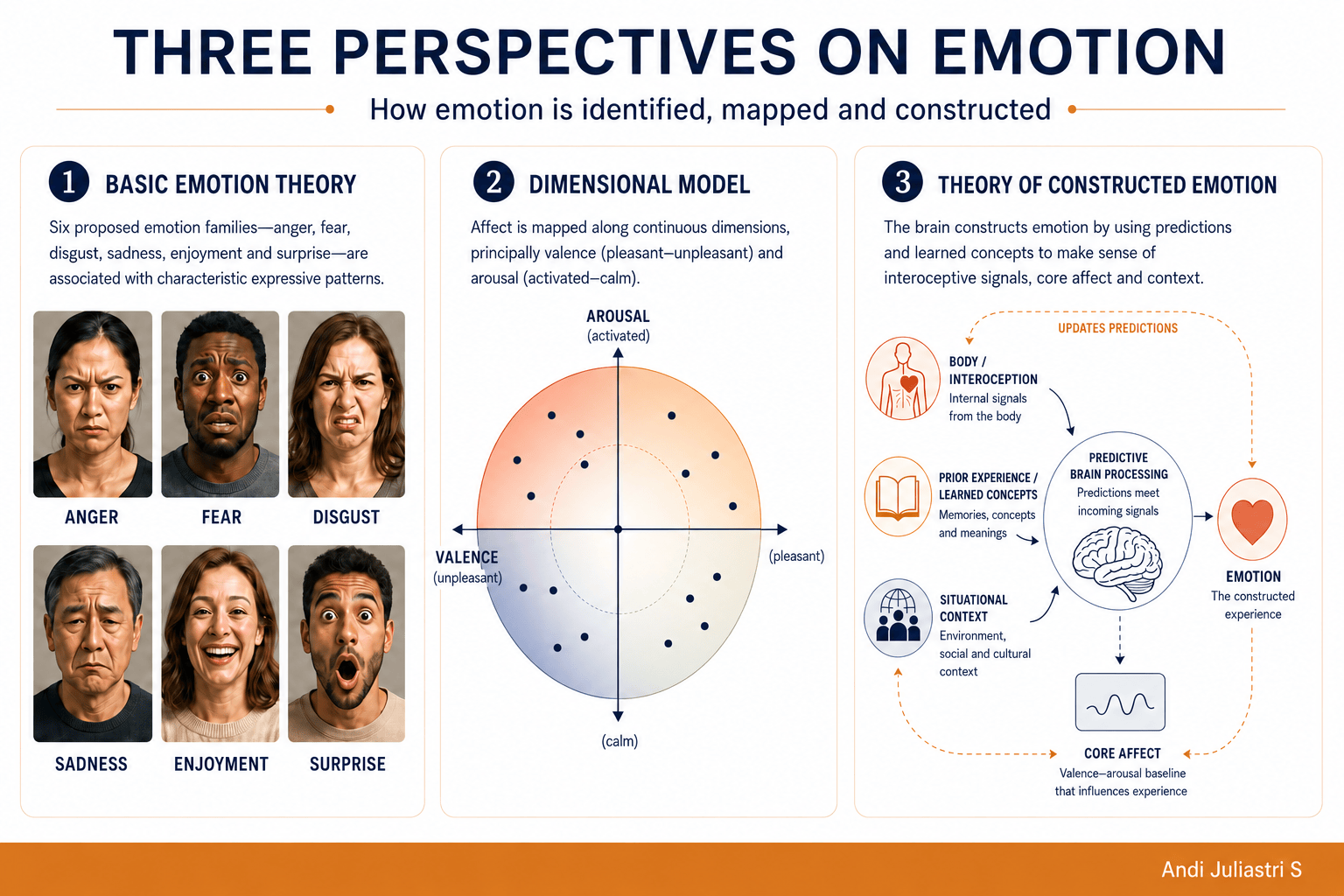
According to the theory of basic emotions, humans have an innate ability to experience anger, disgust, fear, happiness, sadness and surprise, which are known as discrete emotions. Designed and endowed to every single human being by the universe, whom some people call God, discrete emotions are biological fingerprints of different feelings, which can be traced on specific brain regions and are detectable by physical cues, for instance facial expressions. In other words, the classical theory suggests that every human being will display similar patterns of facial expression when feeling angry, regardless of their geographical and socio-cultural background. The theory originates from the essentialist biological view rooted in the Darwinian paradigm, a school of thought that explains emotions by tracing its physiological and behavioural signatures. One of the arguably most significant scientific contributions of this theory is a widely-accepted scale of discrete emotions, allowing a precise quantitative measurement of emotional experience and its impact.
Another classical but conflicting theory is known as the dimensional models. The theory posits that emotion or in this case, emotions don’t have clear categorical differences. By contrast, dimensional theories don’t define emotions as discrete states with unique neurological traces and somatic markers. Instead, the view conceptualises emotional experience as continuous variations in core affect, that is our inherent mood, our tendency to behave either as a hopeless romantic or a brutal pragmatist when caught in a romantic relationship. The theory’s most influential contribution is a framework called the Circumplex model, a two-dimensional space that maps affective states according to valence, from unpleasant to pleasant, and arousal, from low to high activation.
A more contemporary approach to understand emotion offers an alternative theoretical paradigm. Two theories worth-mentioning are the constructivist theory and the semantic space theory. The former, for example, argues that emotion is the end product of a complex coordination between the neurological and metabolic mechanisms of the human body. Proponents of this theory recognise the existence of core affect, yet refute the idea that affect takes a distinct emotional form nor is it generated by specialised brain modules (more to this in the next paragraphs). Subsequently, the theory states that emotions require several ingredients to materialise, which apart from the biological enablers, include sociocultural constructs, such as beliefs, traditions and language. Put another way, emotion is a perceptual experience constructed through the interplay between the body’s interoceptive signals, mental representations drawn from the long term memory, core affect, and the brain’s active prediction of the given situation.
If you are lost, imagine a Christmas season where you were in the kitchen putting a bunch of different stuff into a mixing bowl to make a ginger bread called happiness. For a clearer picture, have a closer look at the graphic below.
Moving from theories to empirical tests, research findings shown by fMRI and PET tests demonstrate a strong correlation between the occurrence of emotions and the activation of different parts of the brain, namely the amygdala, insula, ventral striatum, and the medial/orbitofrontal cortex.
Amygdala is arguably the most studied part of the limbic system, a part in your brain hailed as the emotional brain. If you paid attention during Biology class, you must have heard of both. Amygdala was previously thought of being the brain’s module for fear. Further investigations concerning its role, however, prove that Amygdala has more responsibility than just being the friendly voices that tell us to run when we see a lion. In fact, it serves as an information processing hub for sensory input related to all kinds of affective responses. If you think of it, it unveils the riddle behind this metaphor, “There is a fine line between love and hate”.
Emotion is also associated with high and low arousal of the core affect. For instance, when you can’t sleep out of excitement for tomorrow’s trip to Vegas, there is a part in your brain that is busy anticipating rewards. And that part is called striatum, an area that is illuminated under a brain scan during an emotional occurrence related to gains and pleasure. Striatum is composed of subcortical structure known as nucleus accumbens (NAcc) and olfactory tubercle. NAcc, in particular, functions as the key node in the reward circuitry. Its activation is stimulated by dopamine release, a neurotransmitter famously associated with feelings that are present when the days are filled with sunshine and rainbows. Dopamine is generated by the dopaminergic neurons within the limbic regions, such as hippocampus and ventral tegmental area (VTA). To reach the brain’s ultimate pleasure centre, the neurotransmitter travels via the dopaminergic mesolimbic pathway that bridges the VTA and the ventral striatum.
Referring back to the theories, emotional instances are also mediated by some activities happening in the adrenal gland near your kidney. During an emotional experience, the gland secretes adrenaline hormones, such as epinephrine, to the bloodstream and influences the brain indirectly via the vagus nerve. As an example, in memory formation induced by strong emotional reactions, the released hormones bind to adrenergic receptors found in the vagal sensory fibres. The nerve’s endings called axons connect to the nucleus of the solitary tract (NTS), the brain’s bottom-up information sensor that is located in the brainstem. Neurons in the NTS then execute a synaptic transmission to the locus coeruleus (LC), which is responsible to project signals recognisable by the amygdala – the emotional hub.
Furthermore, the coupling between the insula and anterior cingulate cortex (ACC), the body’s emotional alarm, have also been associated with autonomic arousal from physiological changes in heart rate, blood pressure, respiration, and muscle tone. These important interoceptive signals therefore enable the limbic system to recognise and process information to give rise to emotions. Finally, the prefrontal cortex, the part of the brain that is developed later in adulthood and located outside the limbic system, shows some activities during affective stimuli, particularly in relation to higher-processing and regulation of emotions, the time when you manage to be polite and composed during a heated debate about nonsense.
The biological narrative of the brain’s neuroimaging and the body’s visceral activities gave us an insight into the mechanism underlying the brain and body coordination during emotional instances.
Next time you are caught in a situation that makes your heart pound, your muscles strain, and your brain fill with thoughts that make tears drop, you will have an idea of what precedes such reactions and how to best respond to them. For example, when you are about to make a big decision, such as quitting a job, buying a house, or moving to a new country, and you experience any of those interoceptive signals, it is advisable to pause, recognise the sensations for what they really are, and manage the thoughts that come with that.
Paired with the three theories, can we now ask ourselves and tell precisely what emotion is?
From my take, three folds. First, emotion does have different faces. Anger and happiness both appear in different colour and sensation, or in different concept, if you like. However, its interpretation will depend on your upbringing and personal experience. Knowing yourself, having a good relationship with your intuition, and understanding how your own body works are pivotal to acknowledge which kind of emotion you are experiencing. In Neuroscience such skill is known as emotional granularity. Secondly, emotion doesn’t have an exact location in your brain and body. Unlike hormones which are produced by certain glands, emotion is an output of processed sensory information. Your brain, however, does have a specialised hub that coordinates how and where the data is processed.
Finally, emotion remains a complex subject to pin down. The best way to understand emotion is to think of it like weather before the weather vane was invented. It can be sensed, its effects can be observed, but its origins remain a mystery.
